
The industrial sector often faces a difficult choice between rapid project turnover and the long-term structural integrity of assets. Traditional protective layers frequently fail under extreme mechanical stress or aggressive chemical exposure, leading to premature maintenance cycles and ballooning operational costs. A specialized polyurea coating addresses these challenges by merging high-performance chemistry with streamlined application workflows, offering a reliable protective shield for infrastructure.
Facility managers often struggle with downtime during floor renovations or infrastructure repairs. Standard epoxies may require days to fully cure before they can handle heavy traffic. This delay disrupts logistics and impacts profitability. Advanced aliphatic polyaspartic polyurea systems, however, utilize rapid-curing technology that allows for a fast return to service in hours rather than days.
By optimizing the reactivity of the formulation, engineers can achieve surface dryness (tack-free state) in as little as 15 minutes. This speed does not come at the expense of quality. Instead, it provides a dense, cross-linked network that resists mechanical abrasion and achieves early strength development, allowing full support for vehicular traffic and hot-tire pickup within a few hours after application.
Exposure to UV radiation and moisture often degrades standard protective layers, causing them to yellow, crack, or peel. In demanding applications, the priority is maintaining both the aesthetic and structural performance of outdoor assets like wind turbine blades and oil pipelines. A high-solids polyaspartic resin serves as the backbone for these resilient systems, offering inherent UV stability that aromatic alternatives lack.
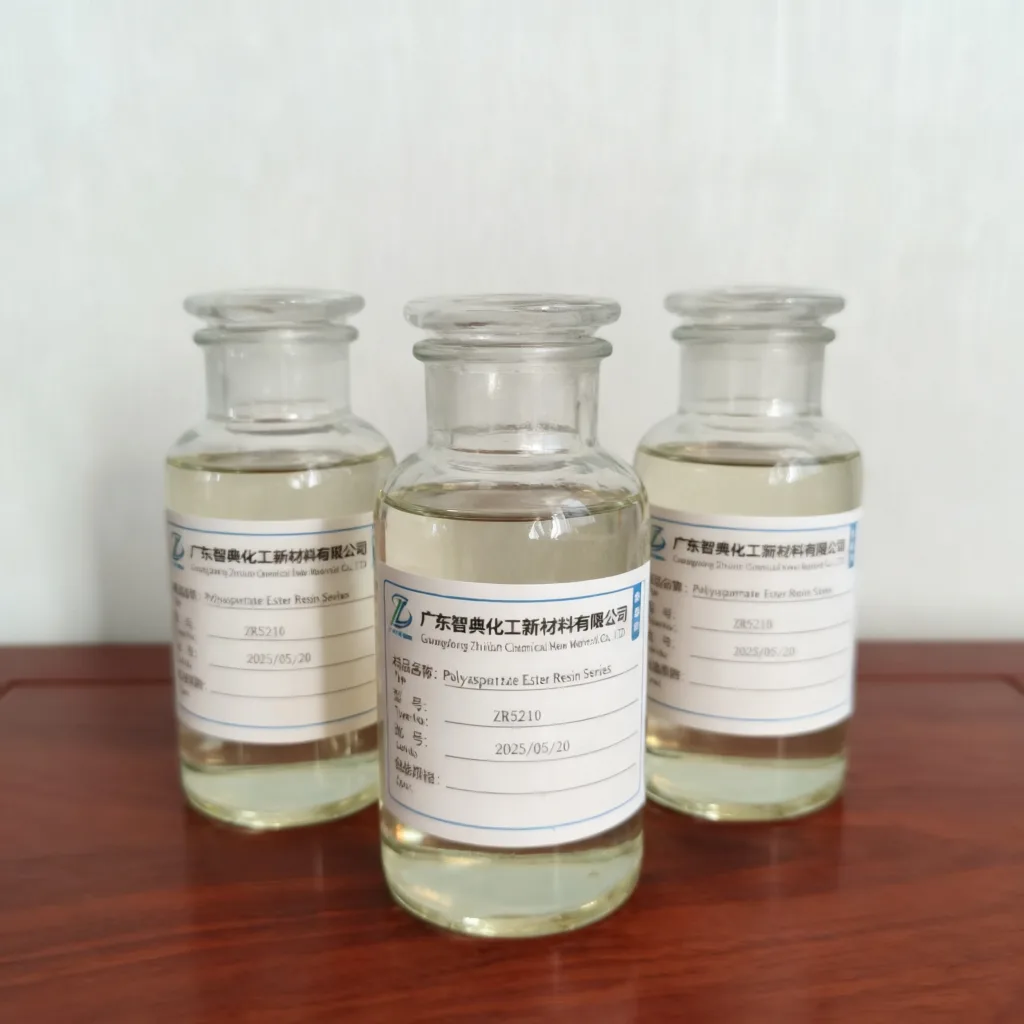
The chemical structure of these polyaspartic materials provides a robust barrier against water, solvents, and salt spray. This level of protection is essential for steel structures in coastal environments where corrosion can compromise safety. The high mechanical strength, often measured by low abrasion loss, ensures the surface remains intact even under heavy industrial foot traffic or sliding equipment.
To understand the practical value of a high-end polyurea coating, one must look at the underlying technical parameters that drive performance.
| Parameter | Value | Practical Benefit |
|---|---|---|
| Solid Content | 97±2% | Low VOC emissions and high film build |
| Surface Dry Time | ~15 Minutes | Extreme reduction in facility downtime |
| Abrasion Resistance | ≤ 20 mg loss | Extended lifespan in high-traffic zones |
| Amine Value | 195-205 mg KOH/g | Consistent reactivity and curing stability |
Poor adhesion to substrates is a leading cause of coating failure. While many industrial projects involve standard concrete and steel, modern asset protection often requires a versatile resin that exhibits strong adhesion to diverse surfaces, including high-performance plastics. For chemical manufacturers, the focus remains on providing stable, high-solids raw materials that simplify the formulator’s job.
When a formulation allows for high film build with fewer layers, the risk of interlayer contamination or application error decreases. For the contractor on-site, this efficiency translates directly into lower labor costs, adjustable pot life for easier manual application, and fewer callbacks.
Does fast curing lead to brittle surfaces?
Not necessarily. While some fast-curing materials can be rigid, the inclusion of specific polyaspartic esters allows for adjustable elasticity. Formulations can be tuned to provide either a hard, scratch-resistant surface or a flexible membrane capable of bridging cracks.
Is polyurea only applied via high-pressure spray?
While traditional pure polyurea requires specialized high-pressure, heated multi-component spray equipment, polyaspartic polyurea chemistry offers a controllable reaction speed. This allows the coating to be easily applied using conventional rollers, brushes, or squeegees, making it highly accessible for varied job sites.
The initial cost of high-performance materials is often offset by the reduction in lifecycle maintenance. Implementing a premium polyurea coating that lasts twice as long as a conventional alternative effectively halves the long-term cost of asset protection. By choosing systems based on rigorous technical standards, stakeholders ensure their investments remain protected against the elements and mechanical wear.
Strategic material selection is about more than just chemistry. It is about solving the operational bottlenecks that hinder growth. By implementing fast-curing, high-durability solutions, businesses can maintain their critical infrastructure with minimal disruption to their core operations.